
 Los Altos, CA

Shockwave therapy is a non-invasive treatment I use every day at PhysioFit to help people heal from chronic pain and injuries that haven’t responded to anything else. By delivering acoustic waves into injured tissue, shockwave therapy stimulates your body’s own repair process — improving blood flow, reducing pain, and rebuilding tissue at the cellular level. In this article I’ll walk you through exactly how it works, what conditions it treats, the different types available, and what to expect if you come in for a session.
9 min read · Educational
Table of Contents
- What is Shockwave Therapy?
- Understanding Shockwave Therapy
- How Shockwave Therapy Works
- Types of Shockwave Therapy
- Conditions Treated with Shockwave Therapy
- Who Should Consider Shockwave Therapy?
- Benefits of Shockwave Therapy
- What to Expect During Shockwave Therapy
- How Long Does Shockwave Therapy Take to Work?
- Shockwave Therapy vs Other Treatments
- When to Consider Shockwave Therapy
- FAQs
- Shockwave therapy is a non-invasive treatment that uses acoustic waves to trigger your body’s natural healing response in injured tissue, tendons, and bone.
- It works by increasing blood flow, stimulating cellular repair, and interrupting chronic pain signals — not by masking symptoms.
- The three main types — radial, focused, and EMTT — are chosen based on how deep the problem is and what tissue we’re trying to reach.
- Most people need three to six sessions and notice meaningful change within four to twelve weeks of starting care.
- It’s a strong option when rest, stretching, exercise, or medication haven’t moved the needle on chronic pain or slow-healing injuries.
What Is Shockwave Therapy?
Shockwave therapy is a non-invasive physical therapy treatment that delivers high-energy acoustic waves into injured or painful tissue to stimulate repair, improve circulation, and reduce pain. It’s used in orthopedic and musculoskeletal rehab to address chronic tendon issues, slow-healing injuries, and pain that hasn’t resolved with traditional care. You can learn more about the service we offer on our Shockwave Regenerative Therapy page.
When patients hear the word “shockwave,” a lot of them picture something electrical or painful. It’s neither. The waves are acoustic — the same kind of mechanical pressure waves you’d get from sound, just at much higher energy. When those waves hit injured tissue, they cause a small, controlled stress response. That stress is what tells your body to start rebuilding.
Understanding Shockwave Therapy
Shockwave therapy sits at a really interesting intersection in physical therapy. It’s not medication. It’s not surgery. It’s not exercise. It’s a way of changing the biological environment of injured tissue so that your body can finish a repair job it started but couldn’t complete.
Most of the chronic pain I see in my practice isn’t caused by tissue that’s still “fresh” injured. It’s caused by tissue that’s been stuck in a low-grade inflammatory or degenerative state for months or years. Tendons that never fully healed. Scar tissue that’s become a traffic jam for blood flow and nerve signals. That’s the space shockwave is designed for.
How Shockwave Therapy Works
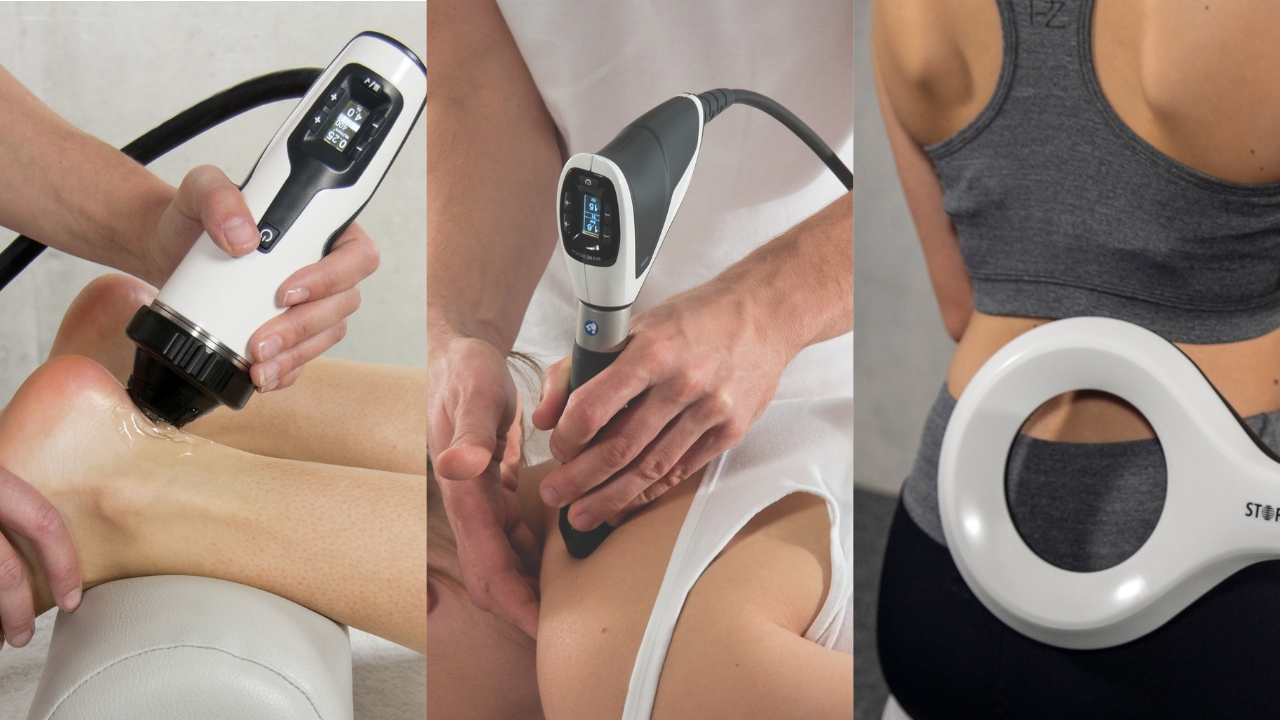
At a high level: we apply a hand-held device to the skin over the area of concern, and that device delivers pulses of acoustic energy into the tissue below. Those pulses do a few things at once — they break up calcified deposits, boost local circulation, and trigger the release of growth factors. The end result is faster, more complete healing and a measurable reduction in pain.
The Science Behind Shockwave Therapy
An acoustic wave is just a pulse of mechanical pressure moving through a medium. In shockwave therapy, those pulses are generated by the device and transmitted through a gel-coupled applicator into your skin. The body absorbs them, and they travel down to targeted depths depending on the type of device used.
When the wave hits dense tissue — a tendon, a fascia layer, a bony attachment — it creates a small mechanical disturbance. That disturbance is interpreted by the cells as a signal to wake up and repair. It’s a clever way to use physics to talk directly to biology. Research groups at institutions like the Ohio State Wexner Medical Center have documented this effect across a range of musculoskeletal conditions.
How It Stimulates Healing
Three main things happen when shockwave energy hits injured tissue. First, local blood flow increases — new capillaries form over the following days and weeks, which gives the tissue what it needs to rebuild. Second, the body releases growth factors and signaling molecules that recruit repair cells to the area. Third, nerve fibers carrying chronic pain signals get quieter, which is why people often feel relief before the tissue is fully remodeled.
Types of Shockwave Therapy
Not all shockwave is the same. At PhysioFit we use three different technologies, and we pick between them based on what’s actually going on in the tissue. Here’s how they compare at a glance:
| Type | Depth | Best For |
|---|---|---|
| Radial (RSW / EPAT) | Surface to ~4 cm | Broad, superficial soft tissue issues like plantar fasciitis or IT band problems |
| Focused (FSW / ESWT) | Up to ~12 cm | Deep, targeted conditions like hip tendinopathy, bone stress, or calcific shoulder |
| EMTT | Whole tissue field | Joint inflammation, bone healing, and complementing radial or focused work |
Radial Shockwave Therapy (RSW / EPAT)
Radial shockwave is the one most people have heard of. The wave disperses outward from the applicator head, so the energy spreads across a broader, shallower area. It’s excellent for surface-level soft tissue issues — plantar fascia, IT band, lateral elbow, upper back muscle trigger points. It also does a great job of increasing circulation in large muscle groups.
Focused Shockwave Therapy (FSW / ESWT)
Focused shockwave does exactly what it sounds like — it focuses the energy down to a specific depth and point, like a spotlight. That lets me reach deep tissue: hip labrum, deep glute tendons, bony attachments, calcific deposits. Focused waves also tend to be better for concentrated chronic pain, where the issue is localized but buried under layers of muscle and fascia.
Electromagnetic Transduction Therapy (EMTT)
EMTT is a newer technology that uses high-energy magnetic pulses instead of acoustic ones. It treats a larger field at once and is especially useful for joint-level inflammation, bone edema, and stubborn tendinopathies. I often combine EMTT with radial or focused shockwave — they hit the problem from different angles and the combination tends to produce faster, more durable results than either one alone.
Why Different Technologies Are Used?
The honest answer is that different problems live at different depths, in different kinds of tissue, with different pain patterns. A plantar fascia problem isn’t the same as a calcific shoulder, even though both are “tendon issues.” Matching the right wave type to the right tissue is what actually gets people better. If you want to dig deeper into how we pick, we wrote a detailed breakdown on choosing the right wave type for your condition.
Conditions Treated with Shockwave Therapy
Common Musculoskeletal Conditions
The conditions I see shockwave help the most are the ones that have been hanging around: plantar fasciitis, Achilles tendinopathy, tennis and golfer’s elbow, calcific and non-calcific shoulder tendinopathy, patellar tendinopathy (“jumper’s knee”), hip greater trochanteric pain, and chronic low back or gluteal trigger points. Some of these have been studied for decades, and the research is strong.
Chronic Pain and Sports Injuries
Shockwave therapy for pain that’s become chronic is one of its best uses. Overuse injuries, stubborn tendinopathies, scar tissue from old surgeries or sprains — these are the cases where people have usually already tried the standard playbook and still aren’t better. Shockwave adds a tool the other approaches don’t have: the ability to directly change the tissue itself. If that’s where you’re stuck, I put together a more detailed read on moving from chronic pain to peak performance.
Other Emerging Uses
Beyond classic orthopedic conditions, shockwave is now being used for pelvic health concerns, slow-healing bone stress injuries, erectile dysfunction, and even some digestive-system presentations tied to fascial and pelvic floor dysfunction. Many of these applications are newer but already backed by growing clinical evidence.
Who Should Consider Shockwave Therapy?
Rather than giving you a list of diagnoses, let me describe the situations where I most often see shockwave make a real difference. If any of these sound like you, it’s worth a conversation.
- You’ve had heel, shoulder, or tendon pain for several weeks or months, and rest or home remedies aren’t fixing it.
- You feel sharp pain with specific movements — first steps in the morning, pushing off in a run, reaching overhead.
- Symptoms go away temporarily but keep coming back the moment you return to activity.
- You’ve done stretching, exercise, or other treatments and haven’t seen consistent, lasting progress.
- Pain is starting to affect your daily life, workouts, or how well you can do your job.
Benefits of Shockwave Therapy
When I talk to patients about what shockwave can actually do for them, five things consistently come up. These are the shockwave therapy benefits I see in the clinic week after week.
No needles, no incisions, no anesthesia. The applicator sits on the skin. That’s a huge deal for anyone who’s been told surgery is the next step.
The waves prompt your own body to repair itself. We’re not adding anything — we’re turning on what should already be working.
Chronic pain signals get interrupted, and low-grade inflammation in the tissue gets cleared. Most people feel this within a few sessions.
As tissue quality improves, joints and muscles start moving the way they’re supposed to. Walking, lifting, reaching — it all gets easier.
Most people walk out of a session and back into their day. There’s no long recovery window and nothing you have to stop doing to heal.
What to Expect During Shockwave Therapy
Your first visit starts with an assessment — I want to understand what’s going on, how long it’s been happening, what you’ve already tried, and what your movement and tissue look like today. If shockwave is a good fit, we build a plan. During an actual treatment session, I’ll position you comfortably, apply coupling gel to the treatment area, and move the applicator over the tissue while the device delivers the waves. Sessions typically run fifteen to twenty-five minutes. You’ll feel a rapid tapping sensation and some pressure — most people describe it as “strong but tolerable.” Afterward you can go right back to normal activity. Some mild soreness over the next 24 to 48 hours is common, similar to the soreness you’d get from a hard workout, and it’s actually a sign that the tissue is responding.
How Long Does Shockwave Therapy Take to Work?
Here’s where I try to set honest expectations. Shockwave isn’t a one-and-done treatment, and it isn’t instant relief. Most conditions need three to six sessions, spaced about a week apart. Some people feel meaningful pain reduction after the first or second visit. Others don’t notice major change until week four or five, when the tissue remodeling really kicks in. Full results — tendons that feel durable, movement patterns that hold up — usually show up four to twelve weeks after the last session, because your body is still rebuilding long after we’ve stopped treating. Shockwave therapy recovery time is minimal between sessions; the longer timeline is about the healing itself, not downtime from the treatment.
Shockwave Therapy vs Other Treatments
People often ask me how shockwave stacks up against the other options they’ve been offered. The short version is that it plays a different role than physical therapy, injections, or surgery — and in most cases it works alongside them, not instead of them.
| Approach | What It Does | Typical Use Case |
|---|---|---|
| Shockwave Therapy | Stimulates tissue healing directly | Chronic or stalled injuries |
| Physical Therapy | Retrains movement and builds capacity | Rehab, prevention, return to activity |
| Injections | Reduces symptoms temporarily | Short-term pain control |
| Surgery | Structural repair or removal | Severe cases after conservative care |
Shockwave Therapy vs Physical Therapy
These two aren’t rivals — they’re partners. Physical therapy rebuilds how you move, strengthens what’s weak, and retrains faulty patterns. Shockwave changes the tissue itself. I use them together constantly: shockwave to wake up the healing, hands-on PT and exercise to rebuild durable function around it.
Shockwave Therapy vs Injections
Cortisone and similar injections can calm symptoms for a few weeks to months, but they don’t heal the underlying tissue, and repeated injections can actually weaken it. Shockwave works the opposite direction — it builds tissue up rather than calming it down. For many chronic tendon problems, shockwave is a better long-term play.
Shockwave Therapy vs Surgery
If you’ve been told you may need surgery for a chronic tendon or fascia problem, shockwave is worth trying first in most cases. It’s far less invasive, requires no recovery period, and in many published outcomes, resolves the issue well enough that surgery is no longer needed. Not every case fits that profile, but for the ones that do, the difference in recovery is significant.
When to Consider Shockwave Therapy
If you’ve had heel pain, tendon pain, shoulder pain, or any persistent musculoskeletal symptom that hasn’t improved after several weeks of rest, exercise, or basic treatment — that’s when shockwave deserves a look. These situations usually involve chronic inflammation, tissue that isn’t healing well, or scar tissue that’s disrupting normal movement. At PhysioFit we don’t start by matching a symptom to a treatment. We assess the root cause — tissue quality, movement patterns, contributing factors, history — and then decide whether shockwave is actually the right tool for what’s going on. That kind of individualized evaluation is what separates symptom management from real healing.
FAQs
Is shockwave therapy painful?+
How many sessions do I need?+
Is shockwave therapy safe for everyone?+
Can I return to normal activities after treatment?+
Is shockwave therapy effective?+
What are the side effects of shockwave therapy?+
How much does shockwave therapy cost?+
Let’s find out if shockwave therapy is the right next step for you. Book an assessment at PhysioFit and we’ll build a plan around what you actually need — serving Los Altos and Silicon Valley.

Kim Gladfelter is a physical therapist, Pilates instructor, educator, author, and founder of PhysioFit Physical Therapy & Wellness in Los Altos, CA. She is a highly regarded expert in healing through movement, women’s health, pelvic floor rehabilitation, and advanced Shockwave Regenerative Therapy — and a trusted voice in the Silicon Valley health community.
Kim has helped men and women of all ages stay active, move without pain, and avoid unnecessary medications or surgery. She writes regularly on physical therapy, pain science, and wellness — and is dedicated to making advanced, evidence-based care accessible to everyone in her community.